QSR · FDD as of 2025 · reviewed July 2026
Popeyes Franchise Cost (2026): Investment, Fees & ROI
Popeyes' total investment runs $505,000-$3.9M, with a $50,000 fee and a disclosed median AUV of $1.9M, one of the more transparent QSR brands on revenue.
$504,545–$3,923,245 total investment 5% royalty
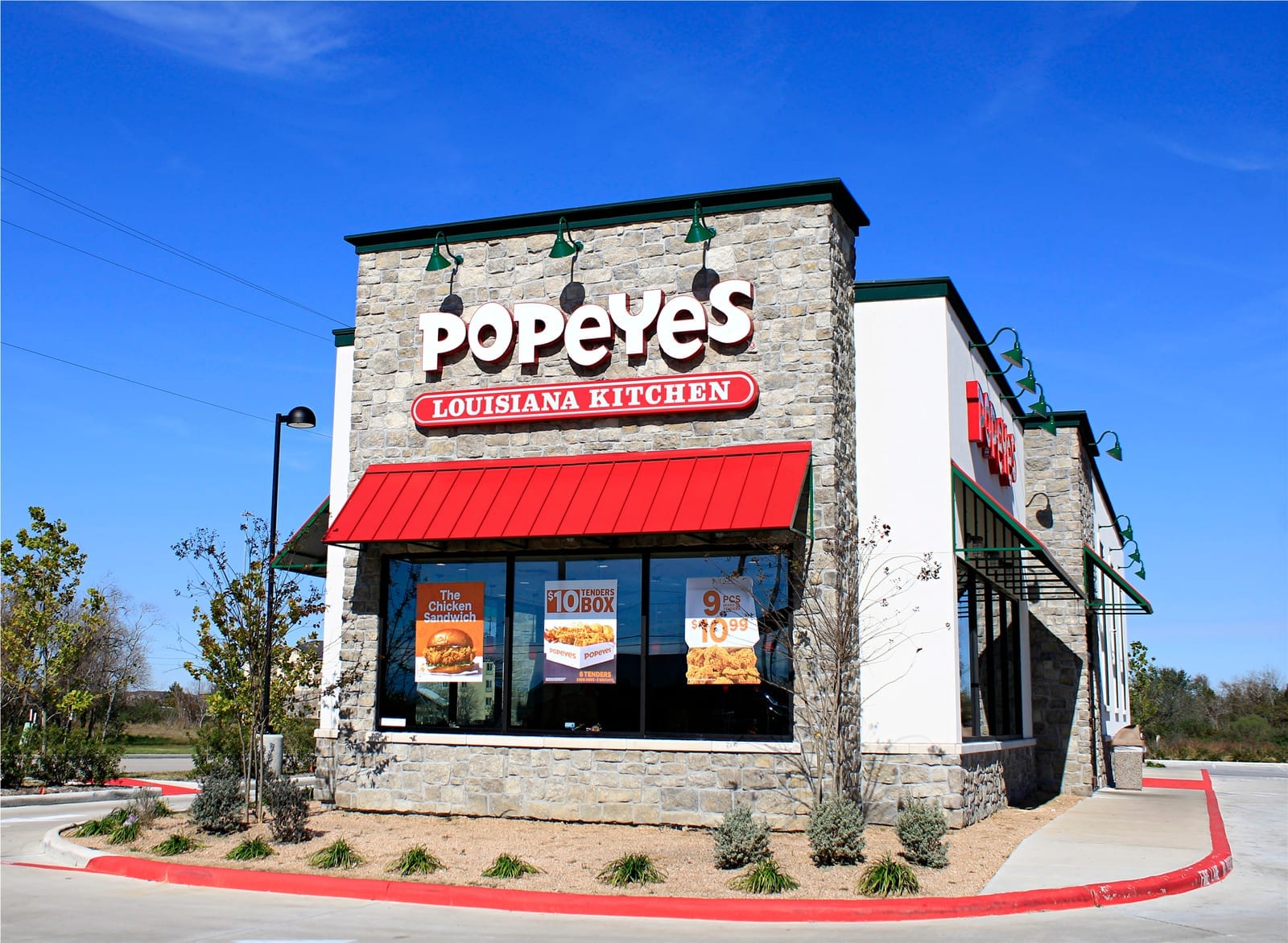
Popeyes franchise cost, itemized
From Popeyes' FDD, as of 2025. Every figure below traces to a specific FDD item.
Total initial investment (FDD Item 7)
$504,545–$3,923,245
The all-in range: franchise fee, build-out, equipment, inventory, and working capital.
- Franchise fee Item 5
- $50,000 $22,500 for qualifying veterans.
- Ongoing royalty Item 6
- 5% of gross sales
- Ad / marketing fund Item 6
- 4% of gross sales
- Liquid capital required
- $500,000 minimum
- Net worth required
- $1,000,000 minimum
Figures from the 2025 FDD or the franchisor's current disclosure. Paraphrased from public filings, not reproduced verbatim. Your actual cost will vary by market, real estate, and build-out condition.
Is a Popeyes franchise worth it?
Average unit revenue (FDD Item 19)
$1,900,000/year
After royalty + ad fund (9%)
~$1,729,000/year
Rough payback read
~1.3 years
This is a rough scale, not a profit estimate. It divides the mid-point investment by revenue left after royalty and ad fund, with no deduction for labor, food or supply cost, rent, insurance, or debt service. Real net margin at a Popeyes location typically runs well below top-line revenue. Ask any franchisee candidate list the franchisor provides for their actual profit-and-loss numbers before you sign anything. Figures as of the 2025 FDD.
3,183 units operating (Item 20, 2025 FDD), a rough health signal: steady or growing counts suggest the model is working for existing owners.
A Popeyes runs $504,545 to $3,923,245 all-in, per the FDD, and that range explicitly excludes buying the real estate. What you’ll actually pay depends on whether you’re leasing an existing pad site or buying dirt and building new.
The more useful thing about Popeyes is that it tells you what a store makes. It discloses a real median average unit volume, around $1.9 million, with its top-quartile locations reporting closer to $2.2-$2.5 million and its bottom quartile down near $1.3 million. That puts it ahead of several QSR competitors (Subway, Taco Bell) that skip Item 19 revenue disclosure entirely, so you get an actual number to model against rather than a guess. Third-party analysis of the same disclosure estimates a roughly 12% net profit margin and owner earnings near $225,000 a year at the median, with payback estimates that vary widely by source, from an optimistic 5-8 years to a more conservative simple-payback estimate near 9.8 years; run your own numbers for the specific unit and lease terms you’re evaluating rather than anchoring on either end.
That real-estate exclusion is the part most first-time applicants miss. The FDD range covers the buildout, the equipment, the signage, and the working capital, but the land and the building sit outside it entirely. On a lease you’re trading that capital cost for a monthly one; on a purchase you’re adding a six- or seven-figure line the disclosed range never showed you. Ask what shape the building is in before you sign anything, because a pad site that needs a new roof or a grease trap is a cost the FDD also never mentions.
A real veteran incentive
The standard $50,000 franchise fee drops to $22,500 for qualifying military veterans, a concrete, quantifiable discount rather than a vague “veteran-friendly” marketing claim. If you qualify, that’s real money back in your pocket before you’ve opened a single door.
The financial bar
$500,000 liquid capital and $1,000,000 net worth are the stated minimums, putting Popeyes in a similar qualification tier to several other established QSR brands, accessible to a serious individual operator or small restaurant group, but not to a first-time buyer without significant capital behind them.

A real sales slump worth knowing about before you sign
The disclosed AUV figures above describe a system that was performing well when the FDD numbers were compiled, but the brand’s most recent quarterly results tell a different, more current story. Popeyes’ parent company, Restaurant Brands International, reported a 6.5% same-store sales decline for Popeyes in Q1 2026, its worst quarterly result in roughly two decades and its fifth consecutive quarter of negative comparable sales, a steeper drop than Wall Street had forecast. The company responded by naming a new president, Peter Perdue (previously Burger King’s chief operating officer), to lead a turnaround focused on core menu items, restaurant operations, and everyday value, with executives publicly targeting a return to positive same-store sales in the second half of 2026.
That doesn’t mean the disclosed AUV or margin figures above are wrong, they reflect the FDD’s stated performance period, but it does mean you should ask specifically how a given territory has trended over the last two quarters, not just what the Item 19 disclosure says, before treating the median $1.9 million AUV as a safe baseline for your own projections.
Is a Popeyes franchise worth it?
Popeyes’ real, disclosed revenue figure and its rapid recent growth (chicken-sandwich-category momentum has been a genuine tailwind in prior years) make it one of the more evaluable brands in this tier on paper. The 9% combined ongoing fee (5% royalty plus 4% ad fund) is moderate for the category, and the disclosed $1.9M median AUV gives you an actual number to run payback math against, something several competitors on this list simply don’t offer. But the current sales slump is a real, recent, and material fact, not a hypothetical risk: five straight quarters of negative same-store sales and a leadership change aimed at reversing it are exactly the kind of thing a prospective franchisee should be asking existing operators about directly, not something to discover after signing a 20-year agreement.
Curious how Popeyes stacks up against another brand you're considering? Compare it side by side against up to three other franchises.